
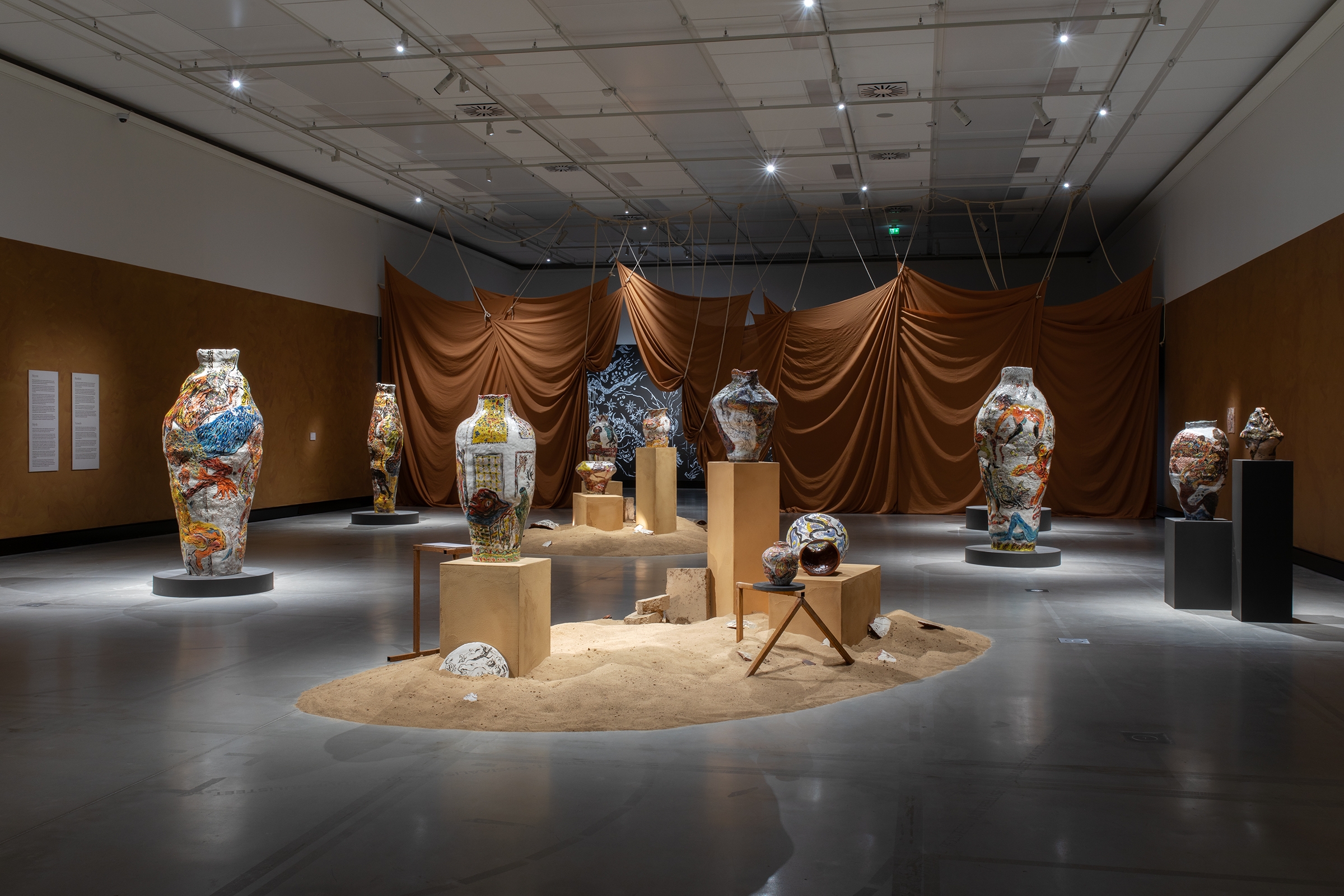

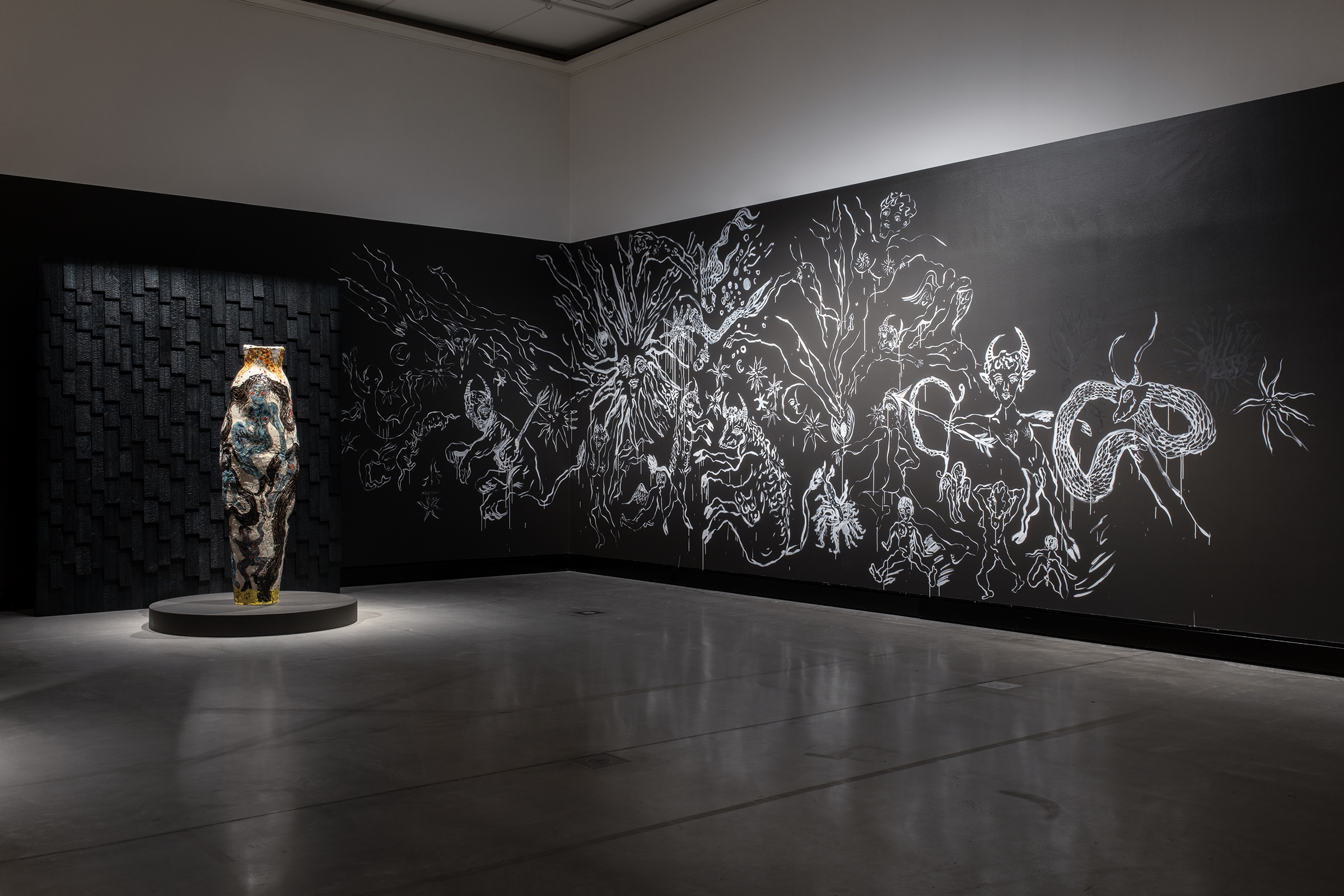


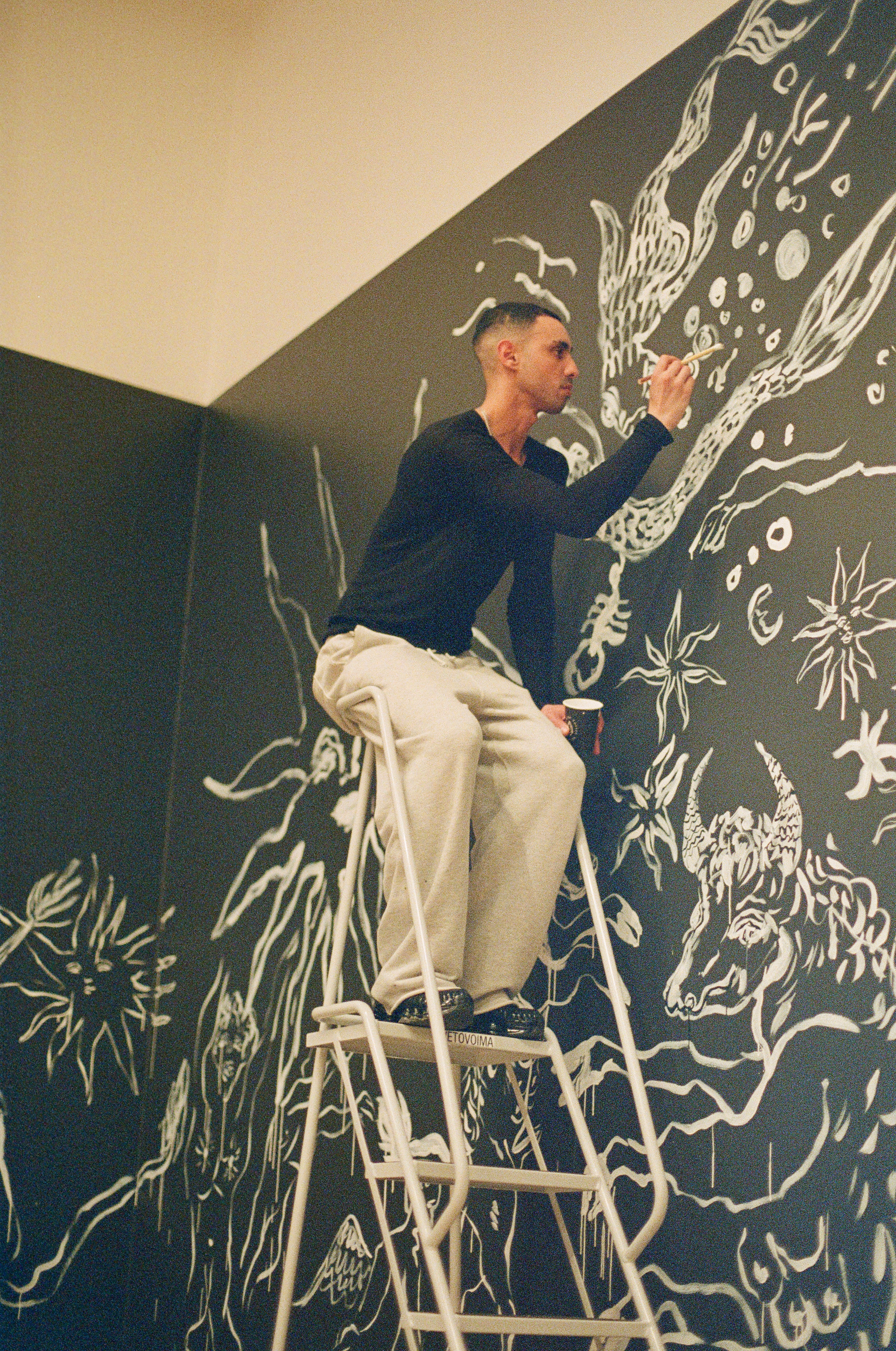

Boumjimar’s works are rich in animal symbolism. His creatures embody instinct and other-than-human energies. Often read as symbols of transition, birds feature prominently in his imagery. Peacocks hold special significance for the artist: highly charged symbols of splendour, extravagance, and erotic display, they are also associated with immortality in many cultures. Some human figures and imagery draw inspiration from club culture, where bodies dissolve through music, sweat, and intimacy, then reassemble in a communal, shared ritual. In this context, the peacock’s theatricality becomes a metaphor for self-expression and desire. The decorated surfaces teem with fish. Living in water – a symbol of life’s origins and the subconscious – fish evoke mystery, hidden emotions, and dreams. They swim with or against the current, representing both conformity and resistance. Boumjimar’s art explores the tension between these two strategies of response. The artist describes identity as being waterlike: ever-flowing, ever-changing. By exploring underwater themes, he also addresses the pollution of our moral environment. Society is governed by visible and invisible rules that dictate how we are allowed to love, move, and exist. Boumjimar’s works position themselves outside these structures, stretching them until they begin to dissolve. In his art, alternative ways of living are proposed and celebrated.
Myths are traditional stories, often originating in ancient times and passed down orally. They typically explore fundamental human questions, from mortality to the origins of the world. The mythical creatures and events portrayed in Boumjimar’s works are not merely allusions to past eras or storytelling traditions. They also offer a way of approaching primordial forces and complex themes such as desire, ecstasy, death, otherness, and metamorphosis. Many of Boumjimar’s titles similarly allude to myth. Dionysian Demon invokes Dionysus, the Greek god of fertility, wine, and ecstatic transformation. The term “Dionysian” suggests not only celebration, but also the dissolution of identity, collective trance, and animalistic power. In this context, a demon is not necessarily a malevolent being, but rather an inner spirit or force that takes possession. Elysian Dolls, in turn, refers to Elysium, the place of peace and light that follows death in Greek mythology. When paired with “dolls” – the affectionate term used in the LGBTQ+ community for glamorous transgender women – a tension emerges between playfulness and the afterlife, innocence and death. Erect Labyrinth introduces the archetype of the labyrinth into Boumjimar’s network of references. A labyrinth can be both a physical structure and a psychological state: a place of disorientation, searching, and transformation. It suggests movement toward the centre and back again, in a kind of ritual journey.
In this elongated work on paper, the bodies of humans and other creatures intertwine as part of a rich entanglement. The composition teems with scales, fur, genitals, eyes, and other bodily fragments that merge with their underwater environment. Sexuality is ever-present in Boumjimar’s art as a powerful, multidirectional, multifaceted, and transformative force, and this aspect of his work is particularly evident here. Bright colours and shifting scales, positions, situations, and perspectives converge and overlap, forming a fluid and malleable narrative. Hybrid creatures, underwater beings, and non-binary bodies move across the paper from end to end, becoming inseparably intertwined and reshaping one another. Although much power resides in this condition of entanglement, the work also reminds us that social structures can wound those who deviate from the norm. The artist describes the work as a cry for freedom.
Press: Low Ground Pressure, Malva Museum, Daily Lazy, Saliva Live, Etelä-Suomen Sanomat, Mustekala
- Lahti
- 10 April — 13 September 2026
- Curation and text: Kukka Pitkänen
- Spatial design: Päivi Helander
- Photography: Juuso Noronkoski
- Film photos: Klau Skuza